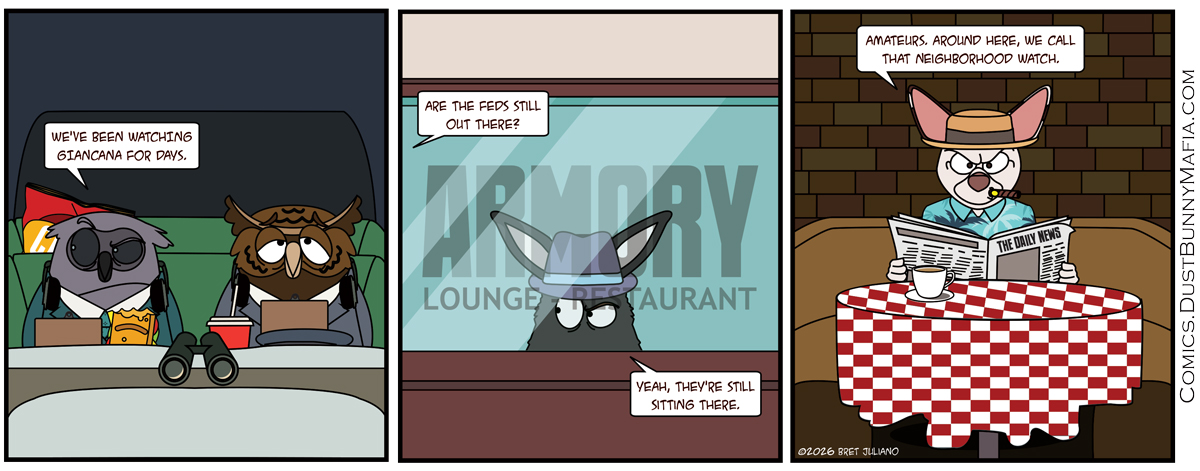


When the FBI kept an eye on Chicago Outfit boss Sam Giancana, he wasn’t content to sit back and enjoy the attention. Sometimes, he watched right back.
In the late 1950s and early 1960s, the Armory Lounge on Roosevelt Road in Forest Park, Illinois, became an important gathering place for Chicago Outfit boss Sam “Momo” Giancana and his associates.
Although it looked like an ordinary neighborhood restaurant and cocktail lounge, the Armory was where Giancana met with fellow mobsters, received visitors, and conducted Outfit business.
Naturally, the FBI took an interest.
As part of Director J. Edgar Hoover’s efforts to investigate organized crime, federal agents devoted considerable resources to monitoring Giancana’s movements and activities. Their methods included physical surveillance, informants, and secretly installed listening devices.
In 1959, agents planted a concealed microphone inside the Armory Lounge. Nicknamed “Mo,” after Giancana’s nickname “Mooney,” the device allowed investigators to overhear conversations about the Outfit’s activities.
But Giancana was hardly oblivious to the government’s attention.
In fact, an FBI report described Giancana using binoculars from inside the Armory Lounge to watch a parking lot across the street.
According to an informant cited in the Bureau’s files, Giancana believed government agencies were using the parking lot of the nearby United States Naval Ordnance Plant to surveil his activities.
The image is amusing: federal agents trying to keep their activities discreet while the man they were watching scanned their suspected observation posts with binoculars.
And Giancana’s frustration with the FBI extended well beyond Forest Park.
In 1963, he took the extraordinary step of suing Marlin W. Johnson, the special agent in charge of the FBI’s Chicago office, over the Bureau’s intensive surveillance.
Court proceedings documented agents following Giancana throughout his daily activities, watching his Oak Park home around the clock, and even trailing him on the golf course. At times, several FBI vehicles were stationed near his residence.
In 1964, the U.S. Court of Appeals for the Seventh Circuit reviewed the case, which raised questions about the limits of government surveillance and Giancana’s rights.
For Forest Park residents, meanwhile, the Armory Lounge sat in a neighborhood where organized crime, federal investigations, and everyday suburban life occasionally intersected in extraordinary ways.
It was a place where the FBI watched the mob, the mob watched the FBI, and keeping an eye on the neighbors could take on an entirely different meaning.
Around here, they might have called it neighborhood watch.

Discussion ¬